Dishwasher Repair in Van Nuys and the Valley
Gray water over the filter, or film on every glass? Tell us which one you're seeing, and the visit goes straight to the drain pump or the wash system.
Gray water over the filter after the cycle
You open the door after the evening load and gray water is sitting over the filter. Call Van Nuys Appliance Care about dishwasher repair anywhere in Van Nuys or the wider San Fernando Valley, and a state-registered, insured tech works through one short path, because a dishwasher that won’t drain usually has a blockage or a failed part somewhere along it.
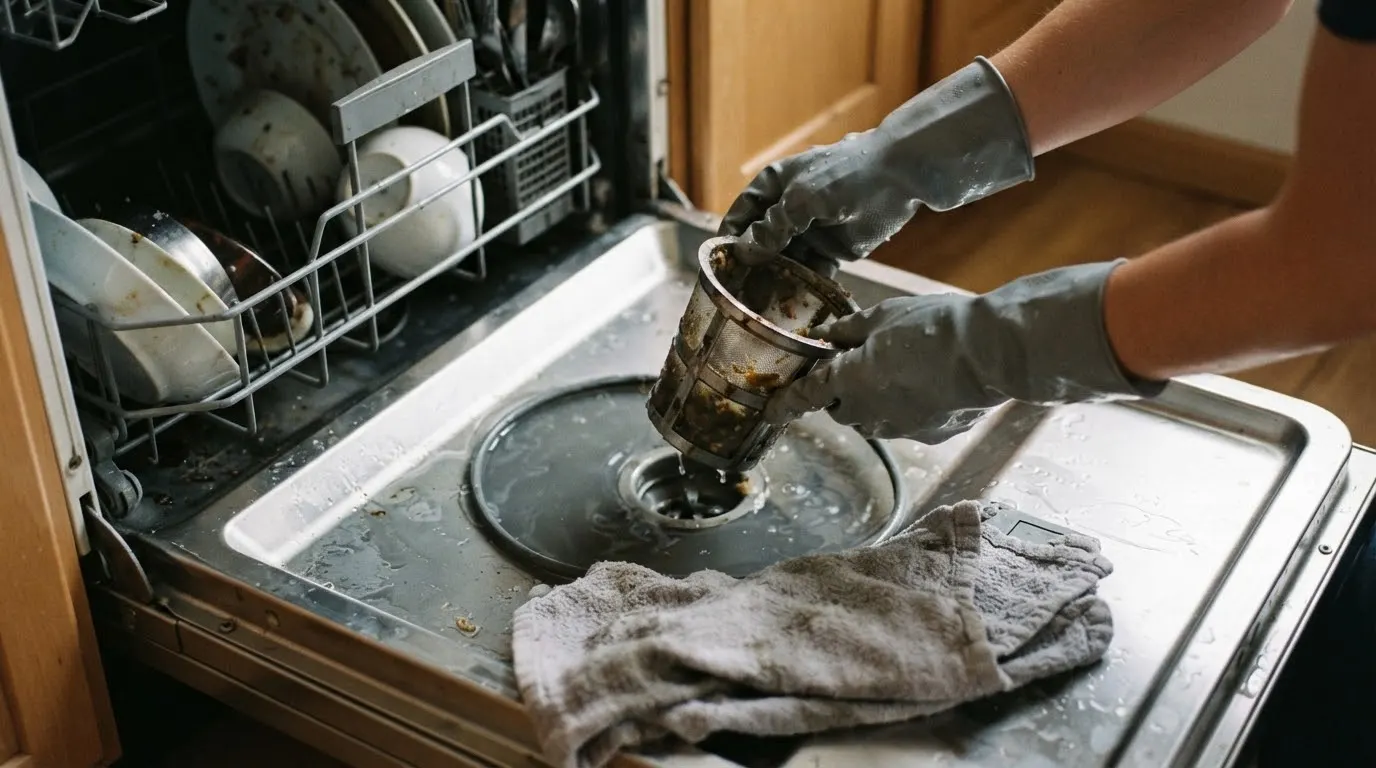
Water leaves the tub through the filter, gets pushed by the drain pump through the drain hose, rises in a high loop or an air gap at the sink, and empties into the sink drain or the garbage disposal. GE’s drain list covers every stop on that path: a packed filter, a clogged air gap, a hose with no high loop or a kink, a slow sink drain, and the knockout plug left in a new disposal. Drain codes such as C2 on a GE, E24 on a Bosch, OE on an LG or 5C on a Samsung all point to that same path.
When the hose and the sink side are clear, the fault is the drain pump, something lodged in it, or the control that runs it. Reaching the pump means pulling the toe-kick panel and often sliding the dishwasher out, and the tech checks the pump for power and movement there.
On the call, say whether the kitchen sink drains slowly too, whether a disposal or sink was replaced lately, and whether you hear the pump hum. The garbage disposal repair page covers the disposal side of the hookup.
Standing water in the tub and a drain code on the panel?
Tell us the code and whether a disposal went in recently. That decides where the tech starts.
Pans come out dirty
Consumer Reports asked owners about more than 77,000 dishwashers, and failing to clean was the top complaint, ahead of failing to dry and failing to drain. Two things decide it: whether water reaches the dishes, and whether it’s hot when it gets there.
| What you see | Common causes | What to tell us |
|---|---|---|
| Food stuck on one part of the racks | Middle spray arm blocked by a tall pan or a utensil hanging through the rack, or an arm that no longer turns (Whirlpool) | Which rack and which part of it comes out dirty |
| Greasy film on dishes | Water arriving below 120°F (GE wants 120°F to 150°F on the hot line), or a heater fault | Whether the tap runs hot at the sink, and any C5 or C6 code on a GE |
| Grit left on glasses and plates | Filter packed with food, or water not circulating | When the filter was last rinsed |
| Little or no water in the tub | Supply valve partly closed, low pressure, kinked inlet hose or a stuck flood float (GE) | Any sound of water coming in, and any H2O or C4 code |
Slow to fill can be normal for the first few minutes: GE allows up to three minutes before water comes in. Past that, the tech checks the house pressure (GE wants 20 to 120 psi), the supply line, the float and the fill valve.
Film or etching on the glasses
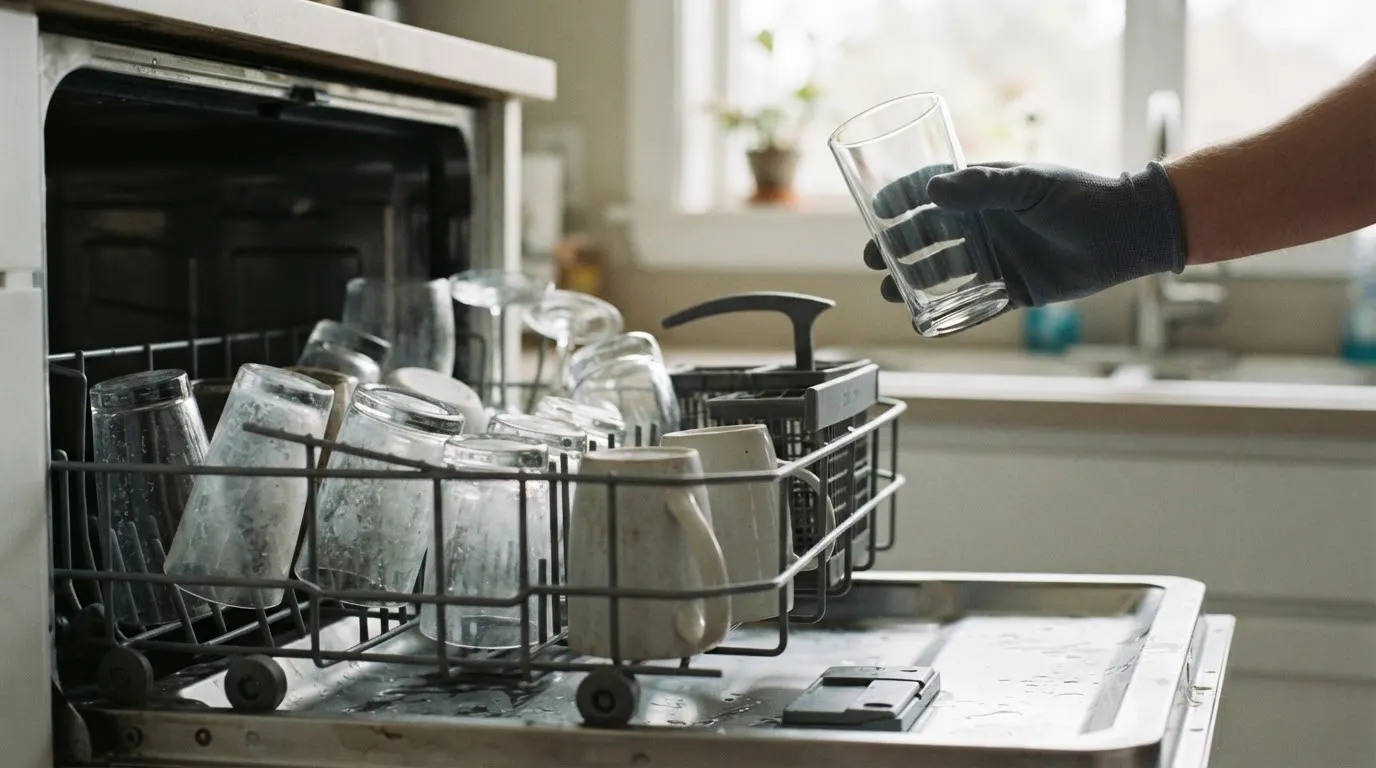
Cloudy glasses come from one of two things. Hard water film is mineral left on the surface, and it cleans off. Etching is the glass surface itself wearing away, which Whirlpool calls irreversible; those glasses stay cloudy. Whirlpool’s quick tell is a little white vinegar on a cloudy glass: film wipes off, etching doesn’t. Tell us which you’re seeing, because film points to water temperature, the rinse aid dispenser or the wash system, while etching points to the detergent and water that’s too soft.
6 to 8 grains: Valley tap water hardness
LADWP’s 2025 water quality report puts the San Fernando Valley’s three sources at about 6.0, 6.7 and 8.2 grains per gallon on average. On LADWP’s scale, 4 to 7 grains is medium-hard and anything over 7 is hard. USGS says the scale heated hard water leaves “can reduce the life of equipment.”
Whirlpool strongly recommends a softener at 15 grains or more, about twice the Valley’s numbers, and says rinse aid matters for hard water deposits. LADWP says even its hardest water doesn’t need softening to be safe or usable. So on LADWP water, film is usually a rinse aid, detergent or temperature question for the tech, and a softener is rarely the fix. Farther out the numbers climb: Simi Valley homes on Golden State Water average about 12 grains (see Simi Valley appliance repair), and Santa Clarita groundwater about 21, covered on the Canyon Country page.
Leak at the door or under the cabinet
GE traces a lot of dishwasher leaks to suds: dish soap from the sink bottle, too much dishwasher detergent, or rinse aid spilled while filling the dispenser. Those leak at the door seam. Water under the unit that isn’t from the house plumbing, GE says, needs service, and so does a leak code: AE or E1 on an LG, LC on a Samsung, LEAK DETECTED on a GE, E15 on a Bosch. The tech checks the inlet and drain connections under the unit, the door seal and the base.
Water spreading under the cabinet?
Close the supply valve under the sink, stop running cycles, and dry the floor so you can see where new water appears. Then call and tell us what the display shows.
Dishwasher repair estimate: pump, fill valve or seal
Typical drain pump part prices are on the cost guide. What moves your number:
- The part: a cleared filter or air gap is a smaller job than a drain pump, a fill valve, a heater or a control board.
- Whether it has to come out from under the counter to reach the part.
- The service call fee, written on the estimate as its own line.
You see the written estimate before anything comes apart, and the repair happens only if you say yes to it. Consumer Reports found stainless steel tubs hold up better than plastic ones, so ask the tech what shape the tub and door seal are in. If the number tips you toward a new machine, the repair or replace guide covers it.
Mention these about the dishwasher
- Brand and model number from the rating tag on the door edge
- Won't drain, won't fill, dishes dirty, glasses cloudy or a leak
- Any code on the display, written exactly as shown
- Whether a garbage disposal or sink was replaced lately
- LADWP or another water supplier, and whether the house has a softener
- Whether it came with the apartment
Stop running cycles, write down the model number, and call. We’ll get your dishwasher draining and cleaning again.
Dishwasher questions people ask before calling
Is some water in the bottom of the dishwasher normal?
A little, on some models. GE says one to two cups of clean water left in the bottom is normal. Dirty water, or more than that, points to a drain problem worth a call.
It quit draining right after a new garbage disposal went in. Why?
The knockout plug is probably still in the disposal's dishwasher inlet. New disposals ship with it sealed, and GE and Bosch both say it has to come out before the dishwasher can drain. Tell us the disposal is new when you call.
My Bosch shows E24 or E25. What do those mean?
E24 is a drain fault, and Bosch points first to a disposal knockout plug. E25 means the drain pump is blocked or its cover is loose, and E23 means the pump itself has failed. Give us the exact code.
How long should a dishwasher last?
About 15 years on average, the figure the Department of Energy used in its 2024 dishwasher rule. Near that age, set the written estimate next to the price of a comparable new machine.